Samgyetang (Korean pronunciation: [samɡjetʰaŋ]) is a variety of guk or Korean soup, which primarily consists of a whole youngchicken and Korean ginseng.[1] The dish's name literally translates as "'ginseng chicken soup" in English.[2] Samgyetang is traditionally served in the summer for its supposed nutrients, which replaces those lost through excessive sweating and physical exertion during the hot summers in Korea.
2010년 6월 23일 수요일
Samgyetang
Samgyetang (Korean pronunciation: [samɡjetʰaŋ]) is a variety of guk or Korean soup, which primarily consists of a whole youngchicken and Korean ginseng.[1] The dish's name literally translates as "'ginseng chicken soup" in English.[2] Samgyetang is traditionally served in the summer for its supposed nutrients, which replaces those lost through excessive sweating and physical exertion during the hot summers in Korea.
Tteokbokki
Tteokbokki, also known as Topokki, is a popular Korean snack food which is commonly purchased from street vendors orPojangmacha. Originally it was called tteok jjim (떡찜), and was a broiled dish of sliced rice cake, meat, eggs, and seasoning.Tteok jjim an early variant of modern tteokbokki, was once a part of Korean royal court cuisine. This type of tteokbokki was made by broiling tteok, meat, vegetables, eggs, and seasonings in water, and then serving it topped with ginkgo nuts and walnuts. In its original form, tteokbokki, which was then known as gungjung tteokbokki, was a dish served in the royal court and regarded as a representative example of haute cuisine. The original tteokbokki was a stir-fried dish consisting of garaetteok (가래떡, cylinder-shaped tteok) combined with a variety of ingredients, such as beef, mung bean sprouts, green onions, shiitake mushrooms, carrots, and onions, and seasoned with soy sauce.[1]
Kimchijeon
Kimchijeon or kimchi jeon (Korean pronunciation: [kimtɕʰi dʑʌn]) is a variety of jeon, or Korean pancake-like dish, primarily made with sliced kimchi, flour batter and sometimes other vegetables. Kimchi, spicy pickled vegetables seasoned with chili pepper andjeotgal, is a staple in Korean cuisine. The dish is good for using up ripened kimchi. Kimchijeon is often recognized in Korean culture as a folk dish of low profile that anyone could make easily at home with no extra budget.
When preparing it is usual to add brine from kimchi, especially that of baechu kimchi, made from Napa cabbage. The brine lends its red color to the batter but is not spicy itself. Along with kimchi, it is served as anju with alcoholic beverages such as makgeolli ordongdongju.
Dak galbi
Dak galbi, also romanized dalk galbi, is a popular South Korean dish generally made by stir-frying marinated diced chicken in agochujang (chili pepper paste) based sauce, and sliced cabbage, sweet potato, scallions, onions and tteok (rice cake) together on a hot plate. It is a local specialty food for the city of Chuncheon, Gangwon Province, where dak galbi originates. Because of its origin, the dish is also called Chuncheon dalk galbi.[1]
It is said that dak galbi appeared after the late 1960s as an inexpensive anju (food that is eaten while drinking) in small taverns, on the outskirts of the city to replace the rather expensive gui (Korean grilled dishes) which are dishes cooked over charcoal. The dish has spread to the main districts of Chuncheon, where soldiers who serve their military service are vacationing. It is also a popular dish for university students who are on a low budget. Dak galbi is cheap and abundant. One of the reasons why dak galbihas been developed there is that the livestock industry thrives in Chuncheon. Due to the cheap price, together with its taste and amount, it was nick-named commoners' galbi or university student's galbi back in the 1970s.[1] Chuncheon has held an annual autumn festival dedicated to dak galbi since 2005.[2]
Samgyeopsal
Samgyeopsal (삼겹살; Korean pronunciation: [samɡjʌp̚s͈al]) is a popular Korean dish. Commonly served as an evening meal, it consists of thick, fatty slices of pork belly meat (similar to uncured bacon). The meat is not marinated or seasoned, and cooked on a grill at the diners' table. [1] Usually diners grill the meat themselves and eat directly from a grill.
Galbi
Galbi or kalbi generally refers to a variety of gui or grilled dishes in Korean cuisine that is made with marinated beef (or pork)short ribs in a ganjang-based sauce (Korean soy sauce).[1] In the Korean language, galbi literally means "rib" and can often indicate uncooked ribs. In addition, the dish's full name is galbi gui, although "gui" (grilling) is commonly omitted to refer to it.
Since galbi is generally made with beef ribs, it may be called "sogalbi" (소갈비) or "soegalbi" (쇠갈비) in Korean, whose prefix, "so"or "soe" (beef) is often omitted as well. However, just like the literal meaning, galbi dish also can be made with pork ribs orchicken. In such cases, the dish is called "dwaeji galbi" (돼지갈비) or "dak galbi" (닭갈비) to emphasize the main ingredient.
Kongguksu
Kongguksu is a seasonal Korean noodle dish served in a cold soy milk broth. It comprises noodles made with wheat flour and soup made from ground soybeans.[1] It is unknown when Korean people started eating kongguksu; however, in accordance with the mention of the dish along with kaeguksu (깨국수, sesame noodle soup) in Siui jeonseo, a Joseon cookbook published around the late 19th century, it is presumed to have originated at least as early as the 19th century.[2]
Galbijjim
Galbijjim or kalbijjim (Korean pronunciation: [kalbitɕ͈im]) is a variety of jjim or Korean steamed dish made with galbi (갈비, short rib).Beef galbi is sometimes referred to as "gari" (가리), so the dish can be called "garijjim". Galbijjim is generally made with beef or pork short ribs. In the latter case, it is called "dweji galbi". [1]
The preferred ingredient for galbijjim is ribs from a calf because of the tenderness and tastiness. Galbi is more expensive than other portions of beef in South Korea, so galbijjim has been regarded as a high-class dish.
Ribs are a fatty cut, so when cooking with the ingredient, surplus fat should be carefully removed. The first step in preparation of ribs is to soak in water for one or two hours in order to remove the blood.[1]
Kimchi
Kimchi (김치; pronounced /ˈkɪmtʃi/, Korean pronunciation: [kimtɕʰi]), also spelled gimchi, kimchee, or kim chee, is a traditionalKorean fermented [1] [2] dish made of vegetables with varied seasonings. It is most commonly made with napa cabbage and other vegetables such as radish, green onion, chive, and cucumber. Kimchi is the most common banchan, or side dish, in Korean cuisine. Kimchi is also a main ingredient for other common Korean dishes such as Kimchi stew (김치찌개; kimchi jjigae), Kimchi soup (김칫국; kimchi gook), and kimchi fried rice (김치볶음밥; kimchi bokkeumbap).
Kimchi is so ubiquitous to Korean cuisine that the Korea Aerospace Research Institute (KARI) developed space kimchi to accompany the first Korean astronaut to the Russian-manned space ship Soyuz.[3] Kimchi has been the subject of a Japan–Korea dispute, after Japanese firms began exporting their own style of kimchi. [4]
tteok
There are traditional sweets eaten as dessert such as tteok. Tteok refers to all kind of rice cakes made from either pounded rice (메떡, metteok), pounded glutinous rice (찰떡, chaltteok), or glutinous rice left whole, without pounding. It is served either filled or covered with sweetened mung bean paste, red bean paste, mashed azuki beans, raisins, a sweetened filling made with sesame seeds, sweet pumpkin, beans, jujubes, pine nuts, and/or honey). Tteok is usually served as dessert or snack. Among varieties, songpyeon is a chewy stuffed tteok served at Chuseok (Mid-Autumn Festival). Honey or another soft sweet material such as sweetened sesame or black beans are used as fillings. पर मिठाई या नाश्ते के रूप में सेवा की है. किस्मों के अलावा, songpyeon एक chewy है tteok

Kimbap, the quintessential Korean snack

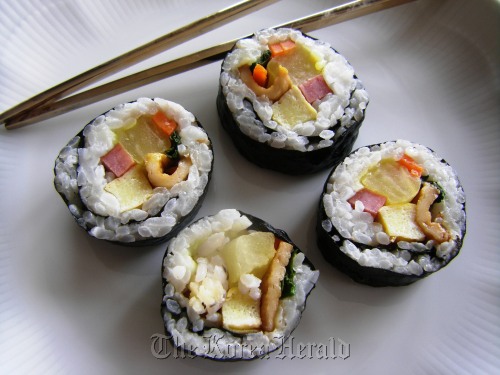
When I decided to do a column featuring ubiquitous Korean snack food kimbap, I knew it would be an emotional piece. My earliest experiences with kimbap are irrevocably intertwined with memories of my dear nanny and housekeeper, who was like a mother to me and a beloved grandmother to my daughters. Ms. Paek, as we always called her, even after she transitioned from housekeeper to full member of our family, passed away about five years ago. She was a wonderful, kind woman, and I miss her dearly to this day.
Ms. Paek would always make us kimbap, and she would serve it so elegantly, as if it wasn’t a common snack food at all, but a delicious gourmet delicacy. My youngest daughter, the baby of the family, loved eating the dried seaweed, or kim, by itself or with rice, so Ms. Paek would accommodate her with trays of kim and rice when she got home from school. For a long time, I didn’t understand the appeal of the crunchy-salty sheets of kim. Ms. Paek tried so hard to help me see the error of my ways. She would smile and say, “Mommy, eat, it is good for you, lots of minerals and vitamins.” Eventually, I had to give in -- who could resist that look of maternal love and caring? Now, I am a kim devotee, and every time I eat it, I think of Ms. Paek, and I thank her for loving my family so well.
Ms. Paek is sadly long gone, and I am left with only the memories of her great accumulated wisdom. As I began to research this column, I realized that everything she had said about the nutritional value of kim is true. I found plenty of research to validate her claims.
The Latin name for seaweed is kelp, the Japanese call it nori, the Chinese refer to it as zicai, and in English, it’s called laver. In this column, I will mostly refer to it as kim, since that is the name I first learned for this incredible food. Kim is seaweed that has been processed by roasting and seasoning. Several edible seaweed species are used to make kim. The process of making edible seaweed is similar to the process of making paper. Kim actually looks a bit like dark green, crinkled paper, but it’s more flexible to the touch. It’s also quite popular -- kim production is a multi-billion dollar industry.
Different varieties and versions of kim are used to make delicious dishes in the cuisines of many cultures. The Welsh use laver to make lava bread, or laverbread, which is made by boiling down seaweed, rolling it in oatmeal, and frying it. It is commonly eaten with bacon and cockles for breakfast. In Japan, nori is used as a wrap for sushi rolls. It is also used in many cultures in soups and as a flavoring. In Korea, of course, kim is used to make kimbap, which consists of glutinous rice, vegetables, and various meats or eggs wrapped in large sheets of kim, rolled into a cylinder, and sliced into bite-size discs of goodness.
Numerous researchers have undertaken research on seaweed. Jane Teas, et al., reported in the Asia Pacific Journal of Clinical Nutrition, June 2009, vol. 18, that it is possible to reverse metabolic syndrome (risk factors include high blood pressure, obesity, and other disorders) through the consumption of seaweed. Teas, et al., stated that metabolic syndrome is on the increase everywhere except for in Asian countries, where diets including seaweed are the norm. The study suggested that consumption of about 4 to 6 grams of seaweed a day may be associated with low metabolic syndrome occurrence.
Jane Teas et al., reported in the Journal of Nutrition, March 25, 2009, that dietary seaweed modified estrogen and phytoestrogen in healthy women. It was noted that postmenopausal Japanese women who ate seaweed and soy foods daily showed a lower rate of breast cancer than postmenopausal women in the West.
An important study in the Nutrition Review Journal, December 2007, vol. 65, part 1, pp 535-43, reveals that kim is highly nutritious. Many articles have been reviewed to validate the claim made by the authors, Paul MacArtain, R. Gill, Mariel Brooks, Ross Campbell, and Ian R. Rowland, who was the investigator of the research. The authors stated that the nutritional value of seaweed, in terms of the fiber, vitamins, minerals, protein, and fat and lipid content is worth noting, and that people should consider eating seaweed on daily basis.
MacArtain, et al., stated the nutritional impact of kim as a source of essential nutrients is quantified. Many kim commercial companies do make many claims about the health benefits of eating kim, which can be misleading, but the nutrients in kim may be comparable to those of the fruits and vegetables that many scientists state are best for humans to eat. MacArtain’s review of the current literature also stated the nutrient content of kim as a food has not been assessed. This is because kim is not a food that is normally eaten in Western countries.
That being said, it is known that kim is high in fiber, carbohydrates, minerals, vitamins, iodine (a trace element), and protein. The fiber content in kim can help produce a feeling of satiety, and it also helps with improving digestion and decreasing colon transit time, which is a great factor in preventing colon cancer. One serving of kim is equal to one banana in fiber content, with 3.8 grams of fiber per 100-gram serving.
The mineral content of kim is also high. Kim is often described as a super natural source of minerals. Calcium is also found in much higher quantities in kim than in other foods, and it’s high in potassium, sodium, iron, copper, and iodine, which is needed for metabolic regulation.
Kim contains many antioxidants, including vitamins and protective pigments. Vitamins A, B, C, and E are all found in kim. All of these vitamins are required for good health. Vitamin B12 is normally found mostly in meats. Vegans who avoid all animal produces will benefit from eating kim, because it is one of the few vegetables that is a good source of B12.
The protein content of kim is excellent. Aspartic and glutamic acids are two powerful amino acids present in kim. These two amino acids are involved in the flavor development of kim.
To conclude, edible seaweeds, such as kim, is high in many important vitamins and minerals at levels that will supplement normal balanced diets. Western society may benefit from using seaweed in form of kim in their diet to improve health.
The following recipe is great for a snack or a light lunch or dinner. Enjoy!
Kimbap
3-4 cups cooked short grain rice, warm
Vinegar mixture to mix with rice: mix 3.5 tablespoons white vinegar with 3.5 teaspoons sugar and ½ teaspoon salt.
4 sheets of kim (19x21 cm)
1 small cucumber
2 eggs, beaten
½ cup carrots
½ cup pickled white radish
½ cup cooked ham, cut in strips
5 teaspoons soy sauce
2½ teaspoons sesame oil
1 teaspoon white sugar
Put cooked rice in a bowl, pour vinegar mixture over rice and mix with a wooden spoon.
Cut carrots into 5 cm long strips, cut radish in strips.
Beat eggs with 1 tablespoon oil, ¼ teaspoon salt, and 1 teaspoon sugar. Pour egg mixture thinly in a greased pan and cook until golden brown. Remove from heat and cut into 4 lengthwise strips. Cut ham into strips. Set all the fillings on a plate.
To fill kim and roll
Lay a sudare (bamboo mat used to roll foods) on table so the slats run horizontally. Put a sheet of kim down with the long side facing you. With dampened hands, spread ¼ cup rice onto it, leaving a 2.5cm border along top edge. Press rice gentle into kim. Arrange cucumber, egg strips, carrots, radish, and ham in contrasting colors in the center. Grasp edges of kim and the mat from the side facing you, lift kim and mat slightly, and roll kim evenly and tightly away from you, pressing down with each quarter turn. Seal roll with a drop of water on far edge of kim. Press seam closed and transfer the roll to a cutting board. Makes 4 rolls in the same manner. With a sharp serrated knife, dipped in hot water, trim ends of rolls and cut each roll crosswise into 6-8 2cm sections. Serves 4-5 as an appetizer.
For Korean restaurateurs in China, it's no cakewalk
![]() |
BEIJING -- With the fastest-growing economy in modern times, the world is increasingly looking to the East to fill the void in demand. Restaurant franchises, too, have jumped into the fray. All major global food chains have -- or trying hard to establish -- stores in major Chinese cities.
The world’s most populous country appears to be a land of promise for many Seoul-based companies as well, which is why an increasing number of Korean food chain operators are trying to tap fast-growing the market.
Sarangchae is a traditional Korean restaurant chain run by a unit of the CJGroup, one of Korea‘s large conglomerates. It has been successfully running a restaurant inside the Beijing Capital International Airport since its opening in 2008. Sitting in Asia’s busiest airport, the restaurant selling homemade-style Korean dishes, including instant ramen noodles, was busy with lunch-goers even at 2 p.m., well after the usual lunch hour, earlier this month.
Bringing hansik to global audience
The trick to globalizing Korean food is not just about exposure.
Getting an international audience to try out a new cuisine also involves helping them understand it, getting them access to it on home turf and enabling them to connect with it on an emotional or cultural level.
The executive producer and producer behind the upcoming U.S. public broadcaster PBS‘ series on Korean cuisine, tentatively titled “Stop and Bap Korea,” and InterContinental Hotels Seoul executive chef Nick Flynn, who helped formulate the hit menu “Made in Korea,” are well aware of this.
Here is a look at their opinions on and their efforts, intentional or unintentional, toward bringing hansik into the international arena.
Bringing hansik into the home
Getting an international audience to try out a new cuisine also involves helping them understand it, getting them access to it on home turf and enabling them to connect with it on an emotional or cultural level.
The executive producer and producer behind the upcoming U.S. public broadcaster PBS‘ series on Korean cuisine, tentatively titled “Stop and Bap Korea,” and InterContinental Hotels Seoul executive chef Nick Flynn, who helped formulate the hit menu “Made in Korea,” are well aware of this.
Here is a look at their opinions on and their efforts, intentional or unintentional, toward bringing hansik into the international arena.
Bringing hansik into the home
![]() |
| Frappe Inc., in collaboration with the Visit Korea Committee, film “Stop and Bap Korea” on Jeju Island. PBS is set to air the 13-episode documentary on Korean food starting January 2011. Oh Sae-young |
피드 구독하기:
덧글 (Atom)